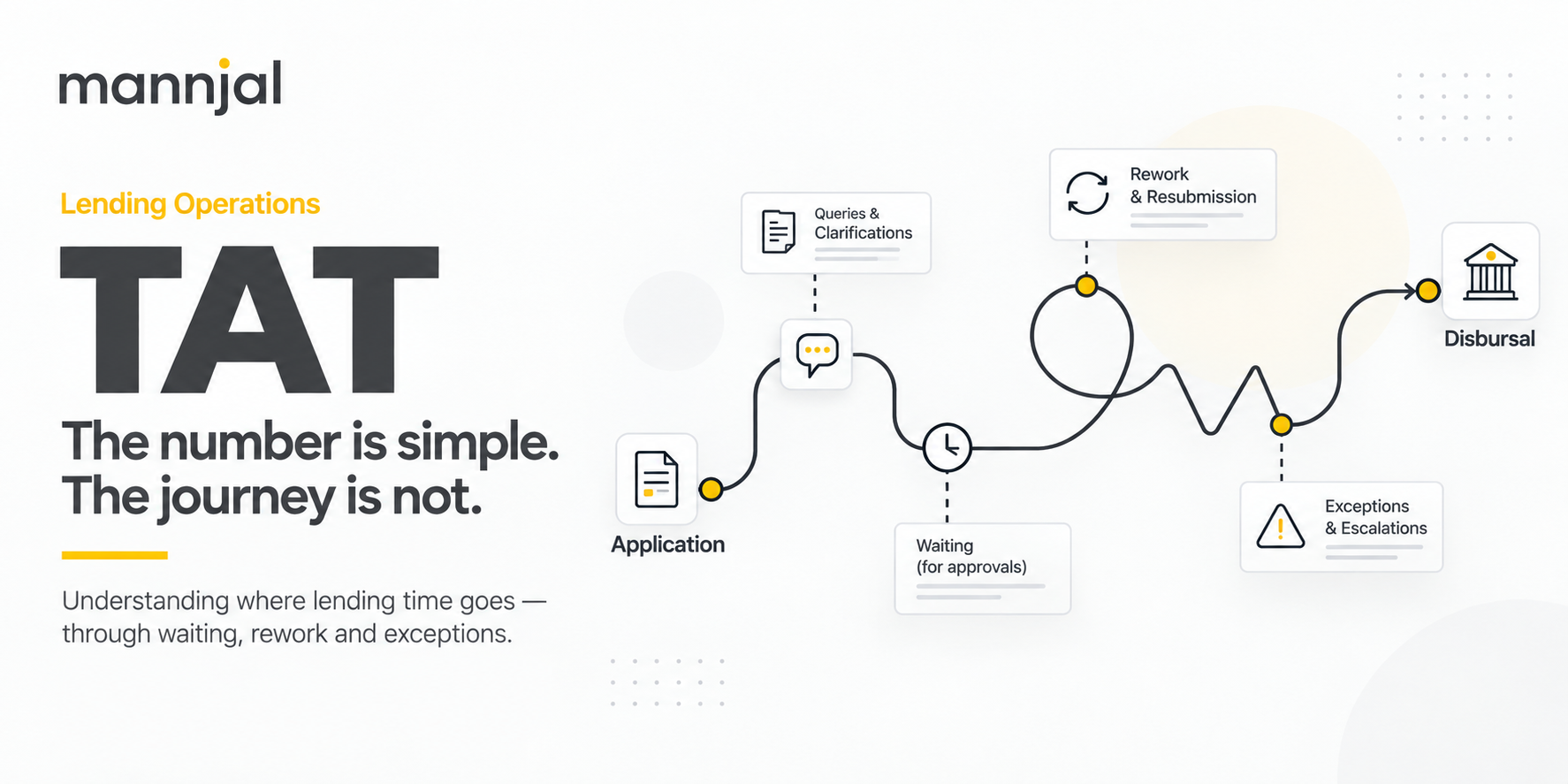
Understanding Lending TAT: Beyond the Headline Number
Turnaround Time, or TAT, is one of the most closely watched metrics in lending.
At its simplest, it measures the time taken for a loan application to move from receipt to disbursal. But the headline number alone does not explain what happened during that journey.
A three-day TAT may reflect a case moving smoothly from one stage to the next. Or it may include waiting periods, repeated clarifications, rework and exceptions that took longer than expected to resolve.
That is why TAT is more useful when viewed not just as a number, but as an indicator of how well the lending process is functioning.
What TAT really measures
A useful way to look at TAT is:
TAT = Productive Time + Waiting Time + Rework Time
Productive time is the time spent moving the case forward through activities such as document review, verification, credit assessment, approvals, fulfilment of conditions and disbursal.
Waiting time is the elapsed time when a case is pending the next required action, such as receipt of information or documents, resolution of a query, completion of a dependent check or an approval.
Rework time arises when an activity needs to be revisited because information is incomplete, inconsistent or requires further clarification.
Some waiting, clarification and rework are inherent in lending. The relevant question is whether the time they consume is necessary, visible and managed well.
Why TAT matters
TAT affects more than internal efficiency.
For borrowers, an extended or unpredictable lending journey can mean repeated follow-ups, uncertainty around funding and difficulty planning the next step.
For lenders, prolonged or inconsistent TAT can increase follow-ups and escalations, create queue build-up, require greater operational intervention and make it harder to identify which cases genuinely need attention.
At scale, avoidable TAT also becomes a capacity issue. Every additional clarification, repeated review or unresolved action consumes operating effort without necessarily moving the case closer to a credit decision. As volumes grow, small delays across individual cases can translate into larger queues, more interventions and lower predictability across the lending pipeline.
So the issue is not simply speed.
It is the quality, capacity and predictability of the lending journey.
Where TAT gets stretched
Avoidable TAT can broadly be traced to three forms of friction: input friction, process friction and exception friction.
1. Input friction
Incomplete or inconsistent information can interrupt processing and create additional rounds of clarification or correction.
Missing documents, incorrect data or mismatches between documents may appear minor in isolation. But when these issues surface later in the journey, activities already completed may need to be revisited.
The impact is therefore not limited to the correction itself. It can also create additional waiting and rework further along the process.
2. Process friction
A lending process may be clearly defined and still lose time between actions.
The involvement of multiple stakeholders is normal. The issue arises when a completed activity does not translate promptly into the next required action because a dependency, response, approval or clarification remains unresolved.
In such cases, the delay may sit not within a formal process step, but between two actions in the process.
Query cycles are another common source of process friction.
Queries can arise between borrowers, credit teams, operations, verification teams, documentation teams, legal or technical teams and other participants in the lending journey.
Queries themselves are normal. What stretches TAT is when they are raised in multiple rounds, identified late, answered incompletely or reopened because the underlying issue was not fully resolved.
Fragmented information can compound the problem. When documents, comments, queries and responses are spread across multiple channels, teams can lose time establishing the latest status, locating the relevant information and identifying what action is still pending.
Individually, these delays may appear small. Across many cases, they can become material.
3. Exception friction
Exceptions are inevitable in lending.
Some cases will require additional checks, policy interpretation, alternate approval routes or further documentation. They may legitimately take longer than a standard case.
The issue is not the exception itself. It is whether the exception has a clear path forward.
At any point, it should be possible to establish:
- what is holding the case,
- who needs to act,
- and what needs to happen next.
When these answers are unclear, an explainable exception can gradually become an avoidable TAT problem.
Building controls around TAT
Improving TAT is not about making every case move at the same speed. It is about reducing avoidable delay around the activities that genuinely need to happen.
Credit assessment, verification, documentation and compliance will naturally take the time required for the case. The opportunity lies in reducing the friction around them.
Useful controls can include:
- validating completeness and consistency at the relevant stage,
- maintaining visibility on actions as they become due,
- defining clear ownership for exceptions,
- routing exceptions promptly to the appropriate decision-maker or point of contact,
- and escalating cases when agreed timelines are crossed.
But controls become valuable only when they create visibility before delay becomes an outlier.
While a case is still live, teams should be able to determine:
- What is currently holding the case?
- What action is pending, and with whom?
- Are any queries or dependencies unresolved?
- Has the case moved backwards for additional information?
- Does an exception require intervention?
Getting those answers requires case-level visibility across the lending journey: a clear current status, defined ownership of the next action, timestamps for key movements, a traceable query-and-response trail and ageing indicators for pending actions or exceptions.
With these in place, teams can identify where a case is slowing down while there is still time to intervene.
That changes TAT management from explaining delays after the event to managing the conditions that create them.
What good TAT should look like
A strong TAT outcome is not simply a low number.
It should be visible, explainable and reasonably predictable.
Comparable cases should move through the process within a reasonably consistent range. When a case does not, the reason should be clear enough for teams to identify whether the delay is expected, avoidable or requires intervention.
That is when TAT becomes more than a retrospective measure. It becomes an operating signal that helps teams act before smaller delays compound into larger ones.
Improving TAT, therefore, is not about making every case move faster. It is about reducing avoidable delay around the work that genuinely needs to be done.
The objective is not the shortest possible lending journey.
It is the shortest responsible journey to a well-made credit decision